

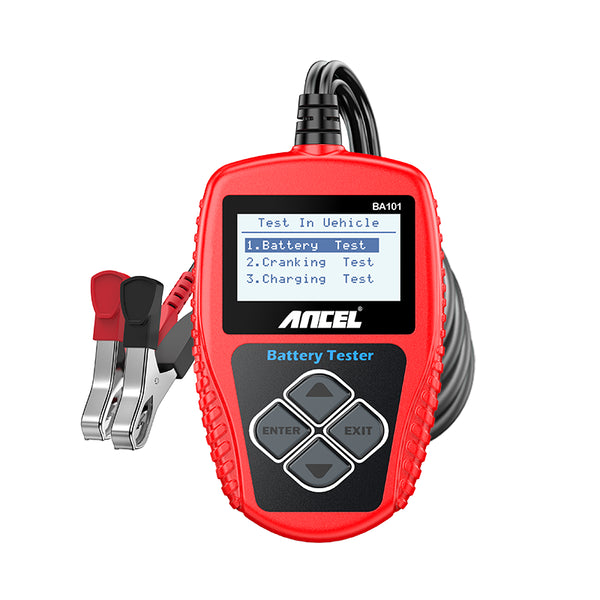
Clip the clamps to the battery, enter CCA, run battery, cranking, and charging tests.
If you want a clear, simple guide on how to use ancel car battery tester, you are in the right place. I have used multiple ANCEL testers for years in shops and at home. This guide shows you what matters, what to avoid, and what your numbers mean. You will learn how to use ancel car battery tester with confidence and save time, stress, and money.

What is an ANCEL car battery tester?
An ANCEL car battery tester is a small, smart tool. It checks battery health with a quick conductance test. It also runs cranking and charging checks. Most models support 12V systems, and many support 24V.
You connect clamps to the battery posts. You pick the rating and test type on screen. Then you read clear results like Good, Recharge, or Replace. This guide explains how to use ancel car battery tester on common models like BA101 and similar units.
Tools and safety prep
Before you start, set the scene. A clean and safe setup gives better data. I learned this the hard way after chasing noise from a dirty clamp.
Use these simple steps before you test:
- Park on level ground and set the parking brake.
- Turn off all loads. Lights, HVAC, radio, and chargers must be off.
- Let the car sit for five minutes to remove surface charge.
- Wear eye protection and gloves if the battery is old or leaking.
- Brush off corrosion so clamps get solid contact.
You will also need the battery’s rating. Look for a label that shows CCA, EN, or another standard. This number is key to how to use ancel car battery tester the right way.
Step-by-step: how to use ancel car battery tester
I will show you how to use ancel car battery tester from start to finish. These steps work for most ANCEL testers with clamps and a simple screen.
Follow these steps:
- Turn the car off. Open the hood and find the battery.
- Connect red clamp to positive. Connect black clamp to negative.
- Power on the tester if needed. Some models power up from the battery.
- Select language and unit options if prompted.
- Choose In-Vehicle or Out-of-Vehicle. Pick the correct setting for your case.
- Select the battery type. Flooded, AGM Flat, AGM Spiral, or EFB if listed.
- Select the rating standard. CCA, EN, SAE, DIN, or JIS.
- Enter the rating value. Use the number on the battery label.
- Run the Battery Test. Wait a few seconds for results.
Now run the other checks to get the full picture.
Battery test
- Do this with the engine off.
- Read voltage, state of health, state of charge, and internal resistance.
- The tester will show a verdict like Good, Good-Recharge, Recharge and Retest, or Replace.
Typical quick ranges:
- 12.6V or more means full. 12.4V is about 75%. 12.2V is about 50%.
- A new battery often shows low internal resistance. A high value hints at aging.
If your result is Recharge and Retest, charge the battery first. Then test again. That is a core tip on how to use ancel car battery tester with accuracy.
Cranking test
- Follow on-screen steps. Most testers ask you to start the car when ready.
- The tool watches the voltage drop while the engine cranks.
- A healthy system often stays above 9.6V during crank at around 70°F.
- In cold weather, a bit lower can be normal. Long crank times mean trouble.
If the drop is very low, the battery may be weak. It can also be a starter issue. Check both if numbers look off.
Charging system test
- The tester asks you to start the engine and hold idle.
- It reads the alternator output and ripple.
- Normal output is often between 13.8V and 14.7V at idle.
- Raise RPM as the tool asks to confirm regulation.
High voltage can harm the battery. Low voltage can drain it as you drive. Ripple can point to a bad diode. Use this step each time you check a no-charge or dead battery case.
These three tests show the full picture. This is the best way to learn how to use ancel car battery tester like a pro.
Understanding results and what to do next
A tester is only as good as the plan that follows. Here is how I read results and take action.
If you see Good:
- Battery, starter, and alternator look fine.
- Keep an eye on age and mileage.
- Use a memory saver if you disconnect the battery for service.
If you see Good-Recharge:
- Charge the battery with a smart charger.
- Retest after charge and a short rest.
- Check for parasitic draw if the issue returns.
If you see Recharge and Retest:
- The battery is low. It may be fine after charge.
- Charge fully, then retest the next day.
- If results still fail, replace the battery.
If you see Replace:
- High internal resistance and low health suggest end of life.
- Match CCA and type when you buy a new unit.
- Run a charging test on the car to protect the new battery.
For cranking and charging:
- Cranking below about 9.6V at room temp points to a weak battery or slow starter.
- Charging above about 15.0V can mean a bad regulator.
- Charging below about 13.3V can mean a weak alternator or belt slip.
This plan helps you act on the numbers when you learn how to use ancel car battery tester.
Common mistakes and pro tips
I see the same errors often. These tips will save you time and help you master how to use ancel car battery tester.
Avoid these mistakes:
- Wrong CCA input. Always use the label number or the maker spec.
- Dirty clamps. Clean both posts and clamp teeth for solid contact.
- Testing right after a drive. Bleed off surface charge first.
- Skipping the charging test. A weak alternator kills good batteries.
Pro tips that work:
- If the car just ran, turn on headlights for 30 seconds, then off. Wait one minute. Then test.
- Record readings in a log. Track SOH and internal resistance over time.
- Test before cold snaps. Cold weather exposes weak batteries fast.
- For stop-start cars, select EFB or AGM as listed. Type matters.
Use these habits as you practice how to use ancel car battery tester on every car.

Troubleshooting: when readings do not make sense
Sometimes the data looks odd. Use these checks before you blame the battery.
Try this:
- Re-clamp and retest. Move the clamp teeth to fresh metal on the posts.
- Confirm the correct battery type and rating standard.
- Test out of vehicle if the in-car test is inconsistent.
- If the car has many add-ons, pull fuses for heavy loads and retest.
Still odd?
- Check for a parasitic draw with a multimeter.
- Check grounds and battery cables for drop. Warm cables can hint at resistance.
- If ripple is high, the alternator may be failing even if output voltage looks fine.
These steps are a key part of how to use ancel car battery tester with real-world cars.
Maintenance and care for your tester
A good tool needs simple care. My oldest ANCEL still reads true because I keep it clean.
Do this after use:
- Wipe clamps and store the cable without sharp bends.
- Keep the tool dry and away from heat.
- Update firmware if your model supports it.
- Compare readings with a shop charger once in a while to verify trust.
If you use a Bluetooth model with an app, update the app too. This helps with bug fixes and new features. Good care improves accuracy as you learn how to use ancel car battery tester for years.
Frequently Asked Questions of how to use ancel car battery tester
What battery types can ANCEL testers check?
Most ANCEL testers support flooded, AGM, and sometimes EFB batteries. Check your model manual for exact types and 12V or 24V support.
Which rating should I enter if I see both CCA and EN?
Use the rating that matches your tester’s options and the label. If you only have EN and your tool defaults to CCA, pick EN and enter that number.
How often should I test my battery?
Test every three to six months, and before long trips or winter. Test after any slow crank, dim lights, or electrical work.
Can I test with the battery disconnected?
Yes, many models support out-of-vehicle tests. Select the correct mode so the tool knows the battery is off the car.
What is a normal alternator voltage?
Many healthy systems show 13.8V to 14.7V at idle. Temperature, load, and smart charging can shift this a bit.
Is a reading below 12.0V always bad?
It means low charge, not always a bad battery. Charge it fully and retest to confirm health.
Conclusion
You now know how to use ancel car battery tester with clear steps. Connect to clean posts, enter the right rating, and run battery, cranking, and charging tests. Read the numbers, confirm with a recharge if needed, and act with a plan.
Use this guide on your car today. Log your results and watch trends over time. If you found this helpful, subscribe for more simple, expert car care guides, or drop a comment with your results.

Evan Mitchel
Evan Mitchell has six years of auto shop work. He has a degree in Automotive Technology. He trains with real tools and real cars and knows how to fix many car parts.